
Mathematics teachers’ self-evaluation of equity-oriented teaching practices
##plugins.themes.bootstrap3.article.sidebar##
##plugins.themes.bootstrap3.article.main##
Abstract
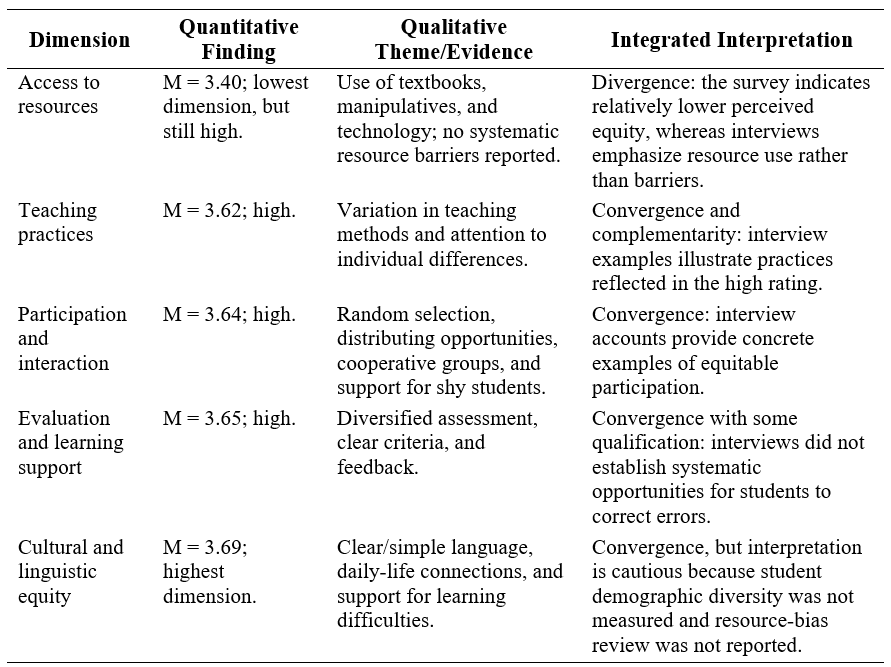
Equity in mathematics education has evolved beyond ensuring equal access to learning opportunities to encompass fairness in addressing students’ diverse educational, social, cultural, and linguistic needs. Within the context of elementary mathematics education in Saudi Arabia, this study investigated teachers’ self-reported instructional practices through a multidimensional lens of mathematical equity. A convergent parallel mixed-methods design was employed, with quantitative data collected through an online questionnaire from 131 elementary mathematics teachers and qualitative data obtained from semi-structured interviews with 12 purposively selected participants. The quantitative and qualitative datasets were analyzed independently and subsequently brought together at the interpretation stage. The findings indicated that teachers generally evaluated their equity-oriented practices positively. Cultural and linguistic equity received the highest mean score, whereas equity in access to instructional resources received the lowest, although all five dimensions were rated at a high level. The qualitative findings illustrated teachers’ reported use of diverse resources and instructional, participation, assessment, and language-support practices, while also showing areas that received less explicit attention, such as systematic monitoring of instructional bias and review of cultural or linguistic bias in educational resources. The findings contribute context-specific evidence on teachers’ self-evaluations of equity-oriented mathematics teaching and highlight the need for further research using classroom observations and students’ perspectives.
##plugins.themes.bootstrap3.article.details##

This work is licensed under a Creative Commons Attribution-ShareAlike 4.0 International License.
The author is responsible for acquiring the permission(s) to reproduce any copyrighted figures, tables, data, or text that are being used in the submitted paper. Authors should note that text quotations of more than 250 words from a published or copyrighted work will require grant of permission from the original publisher to reprint. The written permission letter(s) must be submitted together with the manuscript.References
Abtahi, Y., & Planas, N. (2024). Mathematics teaching and teacher education against marginalisation, or towards equity, diversity and inclusion. ZDM – Mathematics Education, 56(3), 307–318. https://doi.org/10.1007/s11858-024-01602-x
Alibraheim, E. A. (2025). Teachers’ perceptions: What happened after more than 10 years of developing the mathematics textbook. Eurasia Journal of Mathematics, Science and Technology Education, 21(2), em2575. https://doi.org/10.29333/ejmste/15914
Alshalhoub, S. A., ALrashdi, S. S., Alrowili, N. L., Alqarni, R. A., Alalwani, M. H., & ALataw, F. M. (2021). The economic and social situation and its impact on students' performance in mathematics in the PISA 2018 international study in the Kingdom of Saudi Arabia. Ilkogretim Online, 20(6), 857–871.
Alsina, Á., Pincheira, N., Barquero, B., Sellas, I., & Marimon-Martí, M. (2026). Responsive mathematics teaching and mathematics teacher noticing: a systematic review in early childhood and primary education. Mathematics Education Research Journal, 38(1), 25–50. https://doi.org/10.1007/s13394-025-00519-2
Berry, R. Q., & Wickett, M. S. (2009). By way of introduction: Equity: teaching, learning, and assessing mathematics for diverse populations. Teaching Children Mathematics, 16(3), 132–133. https://doi.org/10.5951/tcm.16.3.0132
Celedón-Pattichis, S., Borden, L. L., Pape, S. J., Clements, D. H., Peters, S. A., Males, J. R., Chapman, O., & Leonard, J. (2018). Asset-based approaches to equitable mathematics education research and practice. Journal for Research in Mathematics Education, 49(4), 373–389. https://doi.org/10.5951/jresematheduc.49.4.0373
Crespo, S., Herbst, P., Lichtenstein, E. K., Matthews, P. G., & Chazan, D. (2022). Challenges to and opportunities for sustaining an equity focus in mathematics education research. Journal for Research in Mathematics Education, 53(2), 88–93. https://doi.org/10.5951/jresematheduc-2021-0215
Creswell, J. W. (2014). Research design: Qualitative, quantitative and mixed methods approaches. Sage Publications.
Creswell, J. W., & Creswell, J. D. (2018). Research design: Qualitative, quantitative, and mixed methods approaches (5th ed.). Sage publications.
Darragh, L., MacArthur, J., Ell, F., & Morton, M. (2026). Weaving a web to catch them all: inclusive pedagogies in mathematics. Mathematics Education Research Journal, 38(2), 459–483. https://doi.org/10.1007/s13394-025-00535-2
Education & Training Evaluation Commission (Kingdom of Saudi Arabia). (2021). TIMSS 2019 Report: First insights into mathematics and science achievements of Saudi Arabia students in Grades 4 and 8 in an international context. Education & Training Evaluation Commission (Kingdom of Saudi Arabia).
Gartland, S., Wong, S., & Silverstein, L. (2022). Access, power, identity, and healing in mathematics. Mathematics Teacher: Learning and Teaching PK-12, 115(11), 815–821. https://doi.org/10.5951/mtlt.2021.0305
Gutiérrez, R. (2012). Context matters: How should we conceptualize equity in mathematics education? In B. Herbel-Eisenmann, J. Choppin, D. Wagner, & D. Pimm (Eds.), Equity in discourse for mathematics education: Theories, practices, and policies (pp. 17–33). Springer Netherlands. https://doi.org/10.1007/978-94-007-2813-4_2
Hendroanto, A., Galen, F. v., van Eerde, D., Prahmana, R. C. I., Setyawan, F., & Istiandaru, A. (2017). Photography activities for developing students’ spatial orientation and spatial visualization. Journal of Physics: Conference Series, 943(1), 012029. https://doi.org/10.1088/1742-6596/943/1/012029
Jiang, Y., Lu, C., & Hu, B. (2026). A review of digital technology in informal education and its role in educational equity. Social Inclusion, 14, 10894. https://doi.org/10.17645/si.10894
Joseph, M. (2013). We are all in this together: Equitable mathematics teaching and implications for social justice. Doctoral dissertation. Ohio State University.
Keddie, A. (2012). Refugee education and justice issues of representation, redistribution and recognition. Cambridge Journal of Education, 42(2), 197–212. https://doi.org/10.1080/0305764x.2012.676624
Koutsovasili, M., Katsora, K., & Kaprinis, S. (2024). Teachers’ perceptions of social justice in education and self-efficacy on implementation of inclusive practices. European Journal of Special Education Research, 10(8), 1–16. https://doi.org/10.46827/ejse.v10i8.5701
Lestari, R., Prahmana, R. C. I., Chong, M. S. F., & Shahrill, M. (2023). Developing realistic mathematics education-based worksheets for improving students’ critical thinking skills. Infinity Journal, 12(1), 69–84. https://doi.org/10.22460/infinity.v12i1.p69-84
Litke, E., Wilson, J., & Hill, H. C. (2025). Equity-focused, rubric-based coaching: An incremental improvement approach to supporting teachers to shift toward more equitable mathematics instruction. Education Sciences, 15(4), 444. https://doi.org/10.3390/educsci15040444
Mason, J. (2002). Researching your own practice: The discipline of noticing. Routledge. https://doi.org/10.4324/9780203471876
Meaney, T., & Rangnes, T. E. (2024). Introducing the role of being an advocate in mathematics teacher education. Journal of Mathematics Teacher Education, 27(5), 809–830. https://doi.org/10.1007/s10857-024-09629-3
NCTM. (2000). Principles and standards for school mathematics. National Council of Teachers of Mathematics.
NCTM. (2014). Principles ro actions: Ensuring mathematical success for all. National Council of Teachers of Mathematics.
NCTM. (2020). Catalyzing change in early childhood and elementary mathematics: Initiating critical conversations. National Council of Teachers of Mathematics.
Nguyen, P. (2024). School mathematics as context: examining discourses about the subject in district policymaking. Educational Studies in Mathematics, 117(3), 485–509. https://doi.org/10.1007/s10649-024-10348-y
Nieminen, J. H., Reinholz, D. L., & Valero, P. (2024). “Mathematics is a battle, but I’ve learned to survive”: becoming a disabled student in university mathematics. Educational Studies in Mathematics, 116(1), 5–25. https://doi.org/10.1007/s10649-024-10311-x
Nugraha, D. S., & Nugraha, A. S. (2025). Interlanguage mediated teaching within the multicultural mathematics classrooms: A current trend overview based on bibliometrics. Jurnal Pendidikan Progresif, 15(1), 264–288. https://doi.org/10.23960/jpp.v15i1.pp264-288
OECD. (2021). The state of school education: One year into the COVID pandemic. OECD Publishing. https://doi.org/10.1787/201dde84-en
OECD. (2023). PISA 2022 results (volume I): The state of learning and equity in education. OECD Publishing. https://doi.org/10.1787/53f23881-en
OECD. (2025). PISA 2029 brochure. OECD Publishing. https://www.oecd.org/content/dam/oecd/en/about/programmes/edu/pisa/publications/brochures/PISA-2029-Brochure.pdf
Olawale, B. E. (2025). Equity and social justice in mathematics teacher preparation: Diving into the nitty-gritty. In B. E. Olawale (Ed.), Building the foundations: Effective approaches in mathematics teacher preparation (pp. 1–21). ERRCD Forum. https://doi.org/10.38140/obp3-2025-01
Panthi, R. K., Luitel, B. C., & Belbase, S. (2018). Teachers’ perception of social justice in mathematics classrooms. Journal of Research in Mathematics Education, 7(1), 7–37. https://doi.org/10.17583/redimat.2018.2707
Pourdavood, R. G., & Yan, M. (2022). Teaching mathematics and science through a social justice lens. Journal of Urban Mathematics Education, 15(2), 41–63. https://doi.org/10.21423/jume-v15i2a406
Prahmana, R. C. I., & Suwasti, P. (2014). Local instruction theory on division in mathematics GASING: The case of rural area's student in Indonesia. Journal on Mathematics Education, 5(1), 17–26.
Qiu, X.-L., & Leung, F. K. S. (2022). Equity in mathematics education in Hong Kong: Evidence from TIMSS 2011 to 2019. Large-scale Assessments in Education, 10(1), 3. https://doi.org/10.1186/s40536-022-00121-z
Risdiyanti, I., & Prahmana, R. C. I. (2021). Designing learning trajectory of set through the Indonesian shadow puppets and Mahabharata stories. Infinity Journal, 10(2), 331–348. https://doi.org/10.22460/infinity.v10i2.p331-348
Rizwan, S., & Ali, N. (2024). Teacher educators' perceptions and practices of social justice in Skardu, Pakistan. Qlantic Journal of Social Sciences, 5(3), 228–241. https://doi.org/10.55737/qjss.v-iv.24152
Roberts, M. T., & Almeida, D. J. (2023). Rarely discussed and often ignored: Classroom factors affecting black students’ experiences in developmental mathematics. Journal for Research in Mathematics Education, 54(3), 183–201. https://doi.org/10.5951/jresematheduc-2020-0257
Rosa, M., & Orey, D. C. (2023). Considerations about ethnomathematics, the culturally relevant pedagogy and social justice in mathematical education. Educação Matemática Pesquisa Revista do Programa de Estudos Pós-Graduados em Educação Matemática, 25(2), 145–165. https://doi.org/10.23925/1983-3156.2023v25i2p145-165
Rubel, L., & Meyer, M. R. (2005). Spotlight on the principles: The pursuit of mathematics for all! Mathematics Teaching in the Middle School, 10(9), 479–483. https://doi.org/10.5951/mtms.10.9.0479
Shahrill, M., Putri, R. I. I., Zulkardi, Z., & Prahmana, R. C. I. (2018). Processes involved in solving mathematical problems. In (Vol. 1952, pp. 020019). https://doi.org/10.1063/1.5031981
Subramanian, J., Radovic, D., Xenofontos, C., & Pei, C. (2024). Equity in mathematics education. In Proceedings of the 14th International Congress on Mathematical Education, (pp. 596–601). https://doi.org/10.1142/9789811287152_0077
Suh, J., Aguirre, J., Turner, E., Carlson, M. A., Fulton, E., Tate, H., & McVicar, E. (2024). Exploring Racial Justice with Culturally Responsive Mathematical Modeling in the Primary Grades: Cultivating Criticality in the Problem-Based Learning Space. Interdisciplinary Journal of Problem-Based Learning, 18(1), 5. https://doi.org/10.14434/ijpbl.v18i1.36976
Valoyes-Chávez, L., & Darragh, L. (2024). Interrogating the equity promise for black immigrant students in reformed mathematics classrooms. Educational Studies in Mathematics, 116(3), 479–499. https://doi.org/10.1007/s10649-024-10314-8
van Es, E. A., Hand, V., Agarwal, P., & Sandoval, C. (2022). Multidimensional noticing for equity: Theorizing mathematics teachers’ systems of noticing to disrupt inequities. Journal for Research in Mathematics Education, 53(2), 114–132. https://doi.org/10.5951/jresematheduc-2019-0018
Vithal, R., Brodie, K., & Subbaye, R. (2024). Equity in mathematics education. ZDM – Mathematics Education, 56(1), 153–164. https://doi.org/10.1007/s11858-023-01504-4
Yi, J., Son, J.-W., & Jung, H. (2024). Rethinking anti-Asian racism in mathematics education: the hidden racism made visible through AsianCrit. Educational Studies in Mathematics, 116(3), 423–443. https://doi.org/10.1007/s10649-024-10335-3